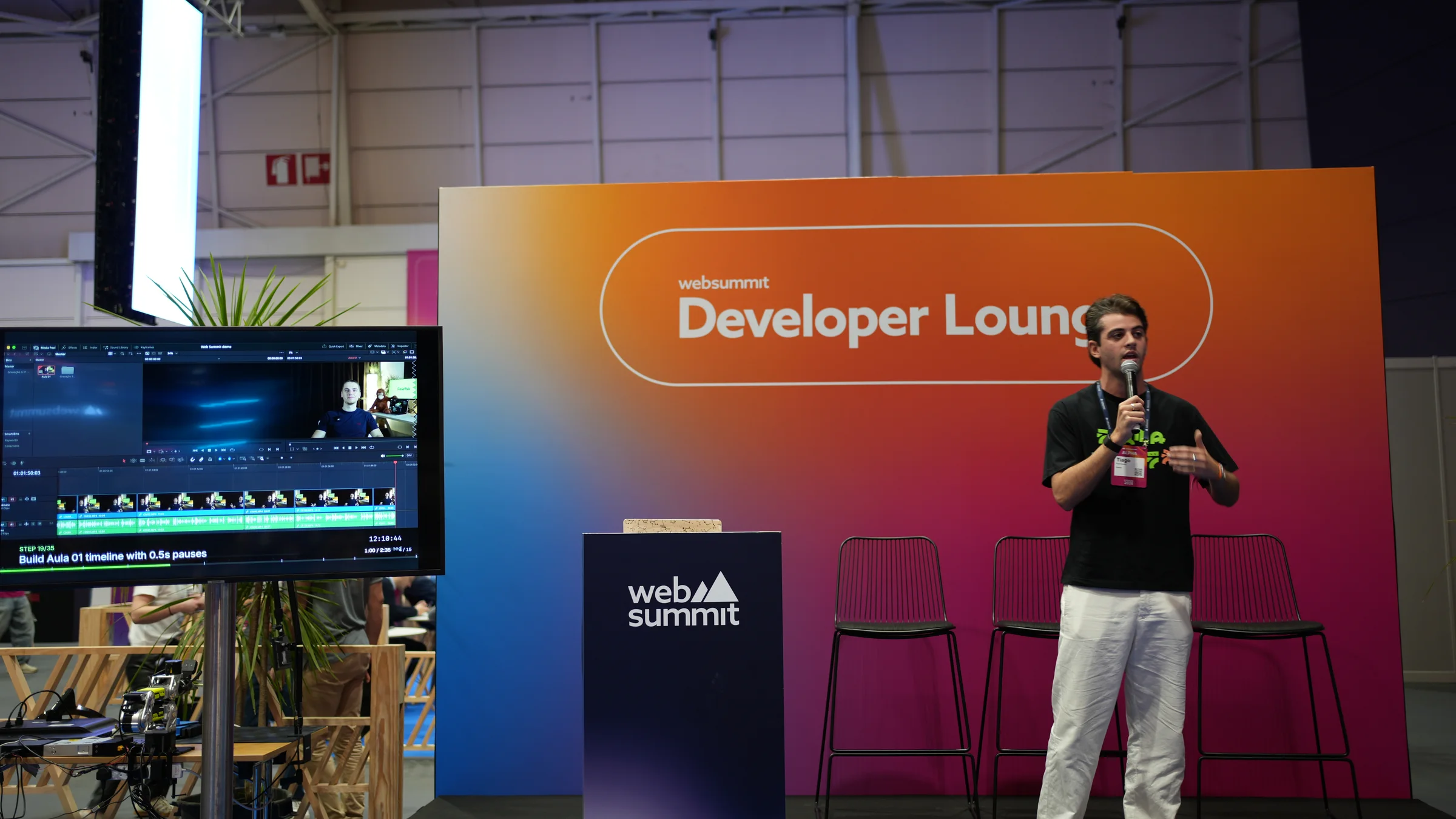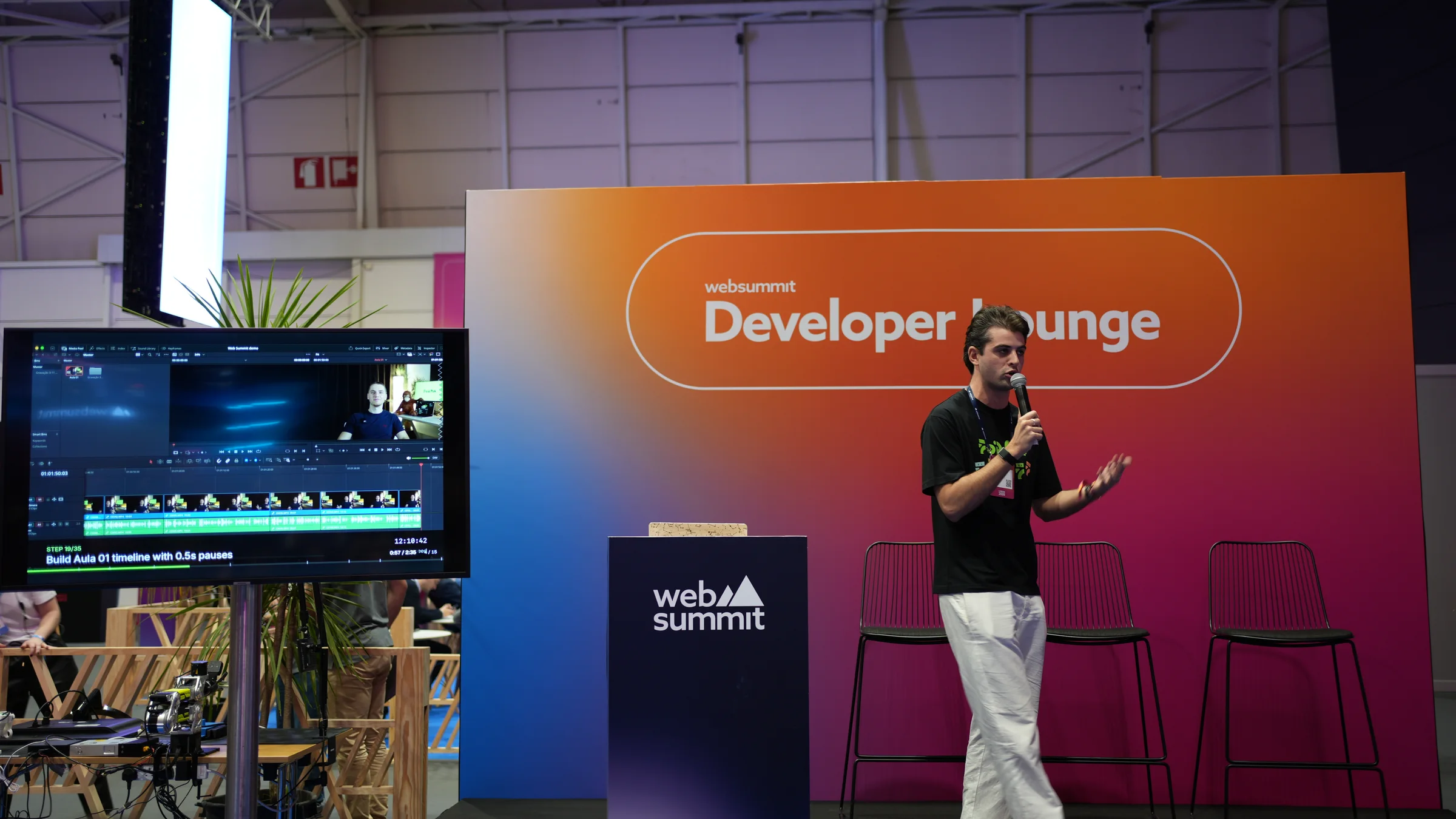
On Tuesday, 10 November, I went on stage at Web Summit's Developer Lounge to show something we do every week: a recorded lesson goes in, a finished episode comes out, and an AI agent does the editing.
It was the Pixels & People session, "From Developers to Founders: Demos, Unfiltered", at 11:00. I opened with a confession. I'm a developer, not a video editor. But since September, a big part of my job has been turning raw lesson footage into finished courses. So I gave that job to an agent.
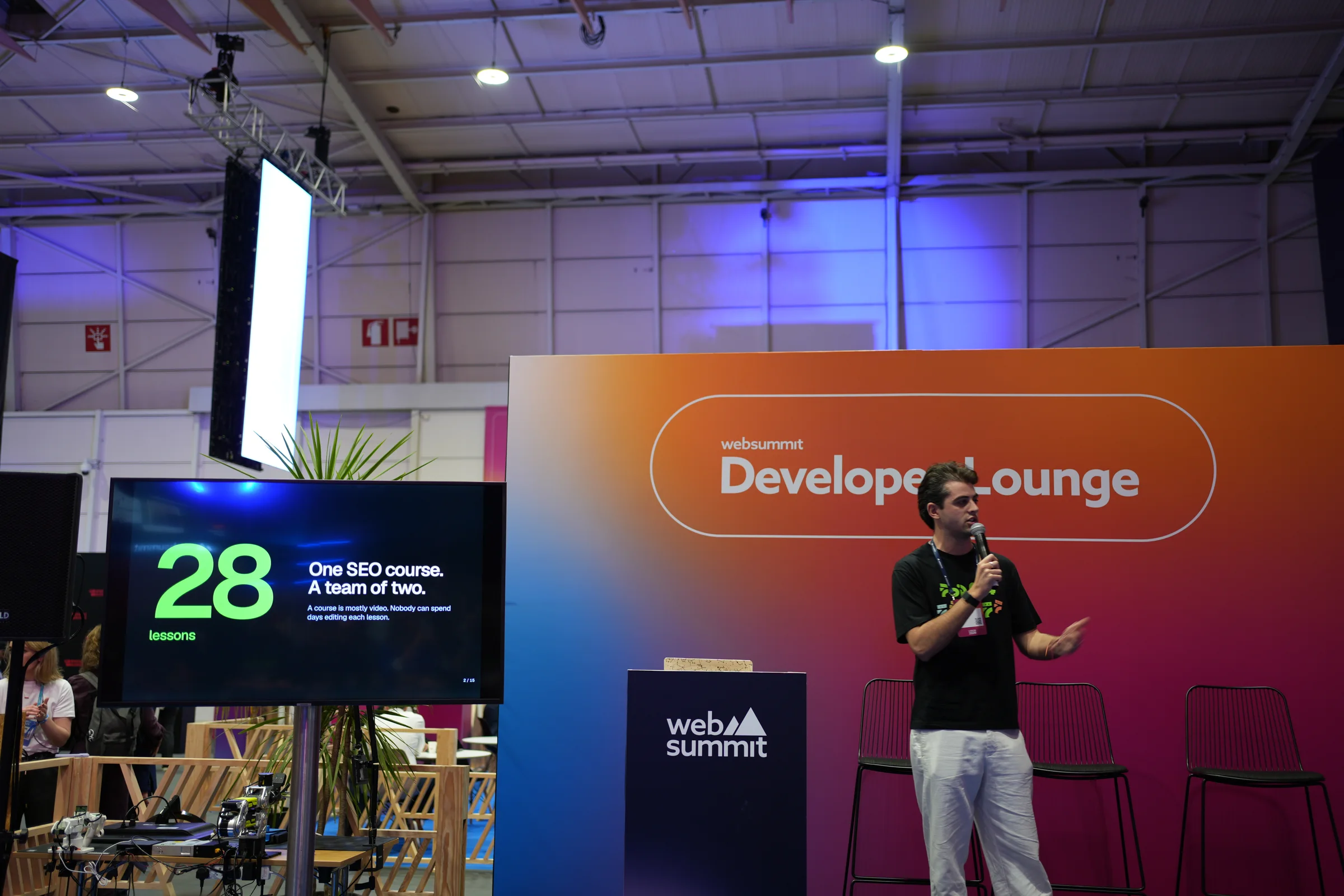
28 lessons, two people
Forma is a digital school in European Portuguese. Two of us built it in eight weeks, and the SEO course alone has 28 video lessons.
A course is mostly video. Nobody can spend days editing each lesson.
What the agent gets and what it returns
It starts with the raw recording of lesson one, taught by Guilherme Presas, who teaches our SEO course. Sixteen minutes, every wrong take included. Five tries at one paragraph, as happens to everyone.
The instruction I give fits in a paragraph. The agent is Claude Code, running on my Mac. First it reads the script and the transcripts of all 34 clips. For every paragraph, it keeps the last complete take.
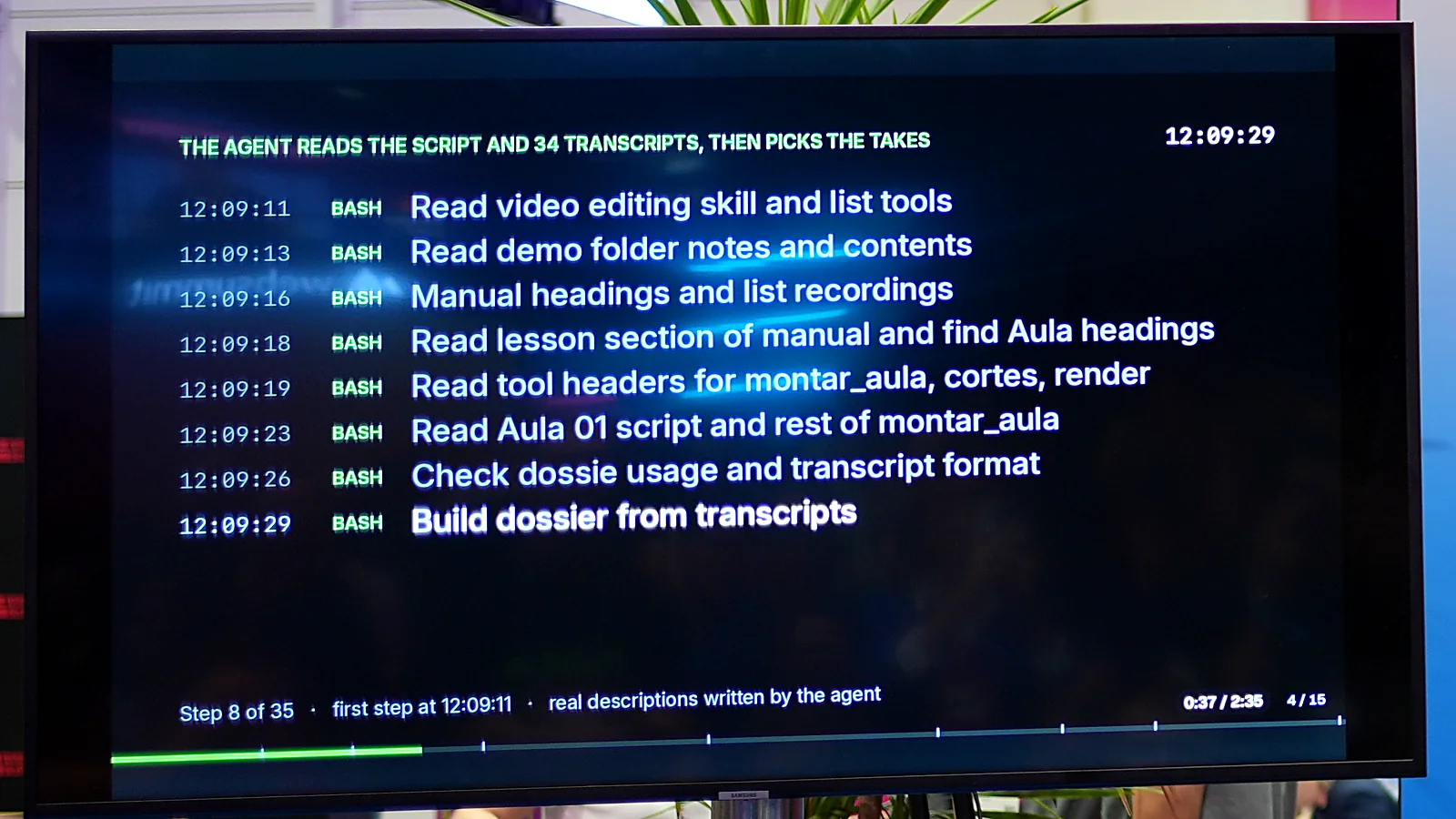
Then it builds the edit in DaVinci Resolve, cut by cut. It is a real timeline. If I don't like a cut, I open it and fix it by hand.
Then it renders and, before I see anything, checks its own work. On this lesson it found two problems: a clap right before the first word, and half a word that had slipped through. It fixed both on its own.
From my prompt to a checked episode took 4 minutes and 37 seconds. Sixteen minutes of footage went in, 1 minute and 47 came out. It cost 1.64 dollars, at API prices.
The same lesson, in English, in my voice
The welcome lesson is mine and it now exists in English, in my voice, with sentences I never recorded. That is two API calls to ElevenLabs. It can't do lip sync yet. If my mouth looks off, that is why.
The cut is the easy part
What we publish has more than cuts. The drawings on screen are code the agent wrote, and each one appears on the exact word that says it.
The same lesson also becomes a Reel, with captions, title and sound placed by the agent. That Reel took seventeen versions, with me saying no.
How a language model edits video
Mostly, it reads. ElevenLabs gives us a time for every word. A cut becomes one clip and two frame numbers. A drawing becomes one line of code that names the words it lands on.
Then FFmpeg inspects every export before I watch it: loudness, frozen frames, a black first frame. And it transcribes the audio again. That is how it caught the clap.
What broke
In October, the agent decided to speed things up and started 96 video encoders at the same time. My Mac froze completely and I had to restart it. Now there is a rule: one at a time.
That is the lesson I take from this. Anything the agent does twice becomes a tool. Anything it gets wrong becomes one line in a file it reads before the next job. Resolve crashes on import? One line. It turned my HDR footage grey? One line: ask Tiago.
The agent does the boring part. The taste stays with me.
All of it is open
Everything ran from one window, T3 Code, an open-source app where every agent conversation is a thread. One thread wrote the talk with me. Another launched the video run.
The code is public, with every rule the agent learned the hard way: github.com/tiagonrodrigues/davinci-resolve-agent.
Thank you to Daria and Pixels & People for the session, and to everyone who showed up at 11:00. The rest of the day is in this recap. Forma's first SEO lessons are free at learnforma.com, in Portuguese for now.
If you teach what you do every day, or you build with agents, tell me what broke.